MONITOR
Watch and log AI usage without changing a thing. The recommended way to start.

INFERENCE
Your teams use enterprise ChatGPT, Copilot, Claude, and Gemini. Secuvy connects as an MCP server between them and your data, and screens every prompt before it leaves your environment.
THE RUN-TIME GAP
Classifying and tagging your training data was the first problem, and knowing what every file is solved it. Inference is the next one: prompts, retrieval, and API calls pull that same data into production on every request.
“Most organizations’ data is not AI-ready, with poorly secured and unstructured data a major barrier to AI adoption.”
GARTNER · MARCH 2026 →A guardrail can only stop what it recognizes. Pattern rules miss the file that matters, and native controls stop at one vendor's walls.
The classification that tagged your data is the same thing that makes a leak visible at run time. That is the piece almost nobody has in place.
THE GO-BETWEEN
Secuvy connects as an MCP server between your people and the models they use. It reads every prompt and file in context, and acts on your policy before anything leaves your environment.
a prompt, a file, an agent, an API call
reads in context · monitor · block · mask · redact
ChatGPT · Copilot · Claude · Gemini
powered by your data, learned in place, so it knows what is sensitive
Watch and log AI usage without changing a thing. The recommended way to start.
Stop a high-risk prompt or file before it is sent.
Send the request with sensitive fields hidden.
Remove the sensitive content and let the rest through.
One policy, set once, holds across enterprise ChatGPT, Copilot, Claude, Gemini, your internal RAG apps, and your LLM API calls. Ordinary work passes untouched.
THE CORE PLATFORM
The go-between recognizes a leak only because the platform underneath already learned your data. Two pieces put that knowledge in place, the same two that run on the homepage.
1.0 · DISCOVER & CLASSIFY
Secuvy learns your data in place across 250+ sources, so at inference it already recognizes your IP, source code, contracts, CUI, PHI, and board material as your organization writes them. A check that knows your data catches what a generic filter cannot.
2.0 · PROVE
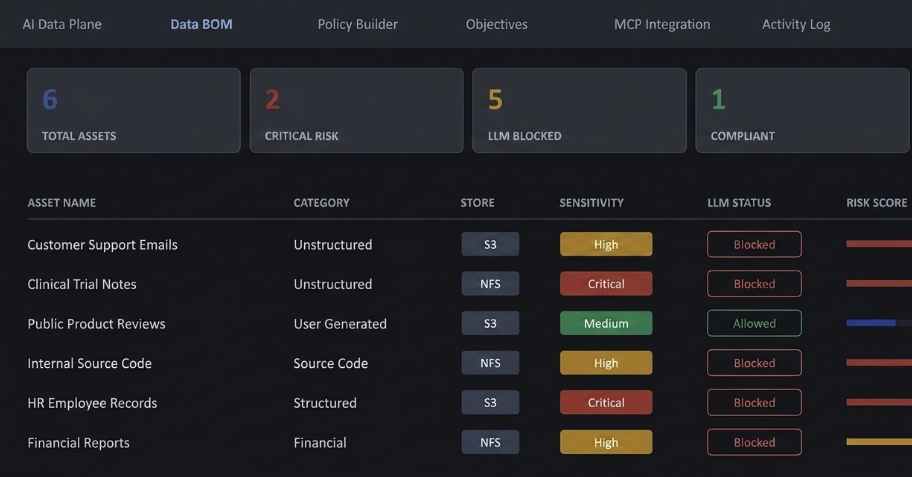
A Data Bill of Materials records what your data is and what each pipeline may use: inputs, exclusions, and status. Put it in place once, and the go-between has the picture it needs to make the right call at inference.
Explore the DBOM →Put these in place once, and the go-between has everything it needs at run time.
IN PRODUCTION FAST
<1 hr
up and running
<24 hrs
first results on your data
250+
sources supported
0
files moved, changed, or touched
Yes, it is model-agnostic. One policy holds across enterprise ChatGPT, Copilot, Claude, Gemini, internal RAG apps, and LLM API calls, so you set rules once instead of rebuilding them per vendor.
Because it already learned your data in place, it recognizes your sensitive files in context, not by regex. The same classification that tagged your data is what makes a leak visible at inference.
Checks run in milliseconds to low seconds, and you choose where deeper analysis applies. Ordinary work passes untouched, and people are stopped only on genuinely sensitive content.
Classification runs inside your tenant. Nothing trains a global model, and you control logs, retention, and deletion. When you remove Secuvy, your data goes with it.
Confidently fuel every AI pipeline.