No labels to start.
Point it at your sources and it learns what sensitive looks like in your organization, before a single document is embedded.

RAG
Every RAG pipeline copies your files into a vector store, sensitive content and all, then retrieves them on demand. Secuvy tags each source before it is embedded, so retrieval surfaces only what you allow.
THE COPY PROBLEM
RAG copies source files into embeddings and an index, sensitive content and all, then retrieves them on demand. The access controls on the originals rarely follow the copy.
“As AI systems rely more heavily on enterprise data, long-standing gaps in data discipline become more visible, and more consequential.”
A retrieval system cannot hold back a file it was never told was sensitive. Once unfit data is embedded, every query can surface it.
Secuvy classifies every source and tags what may be indexed, so the corpus starts clean and stays that way. There are no rules to maintain.
UNDER THE HOOD
No rule sets, no labeling marathons. The gate is accurate because the model never stops learning.
Point it at your sources and it learns what sensitive looks like in your organization, before a single document is embedded.
It recognizes IP, source code, contracts, CUI, and PHI by meaning, the sensitive content a keyword filter would wave into the index.
It runs in your environment, air-gapped, VPC, or hybrid, and nothing it learns from your data ever leaves.
HOW IT RUNS
Two moves, running continuously. Your sources never move.
1.0 · CLASSIFY & TAG
Secuvy connects to 250+ data sources and classifies each one where it lives. It reads content and context, learns what is sensitive, and tags only what your policy allows for the index. Nothing installed. Nothing copied.
2.0 · RE-CHECK
New and changed sources are re-classified automatically, and the index updates against the current classification. Retrieval never surfaces something that was appropriate last month but is not now.
In front of the embedding step. It classifies and tags each source before it is indexed, so only appropriate data ever enters the vector store. It does not move or copy your files to do this.
Embeddings are a separate copy, and the permissions on the originals rarely follow them into the vector store. Secuvy decides what is eligible to be indexed in the first place, so the control holds at the source.
When a source changes, Secuvy re-classifies it and the index updates against the current classification, so retrieval does not surface something that was appropriate last month but is not now.
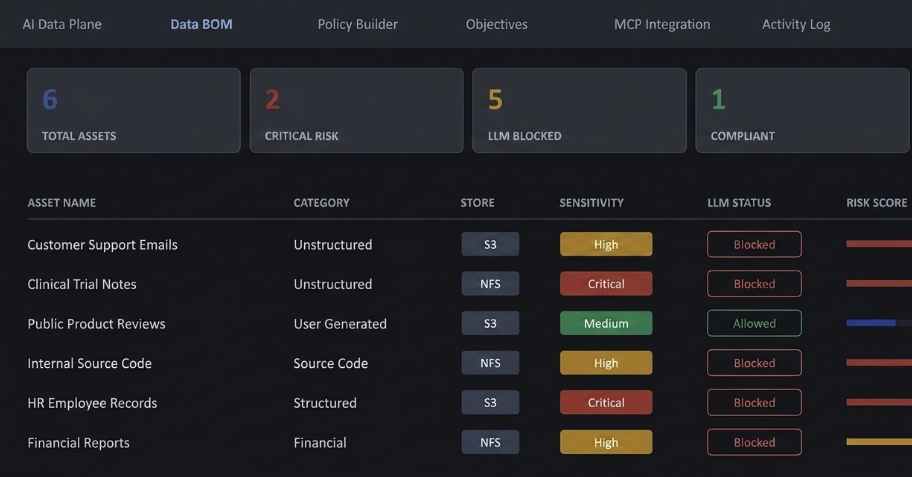
Every pipeline carries a Data Bill of Materials of what retrieval could draw on and what was held out, so the sources behind any answer are already on record.
Confidently fuel every AI pipeline.