The workloads that expand an account are the ones that stall.
Design IP, clinical records, claims and CUI carry the most GPU hours. Tagged, those files can be staged.

FOR NEOCLOUDS & CLOUDS
A customer cannot buy more capacity than the governance team will release. Secuvy classifies and tags customer files inside the customer's own environment, so the workloads sitting in review move onto your platform.
The data that would fill your clusters is proprietary customer data. Design IP. Case files. Claims history. Source code. Nobody on the customer side can say what is in it, so none of it is released to you.
The biggest workloads are the ones the customer cannot approve.
Nothing moves until something identifies that data, file by file, across decades of storage. Pattern rules cannot. Hand tagging cannot.
Two thirds of organizations report having a formal tagging system in place. Only half describe their approach as comprehensive or automated.
Every file the customer cannot identify is capacity you never sell.
An AI that learns the customer's data, confirmed by the customer's own experts, asking for less confirmation every month. Each file is classified where it lives and tagged for which of your regions may take it.
Customers buy more from your cloud when they use the capacity they already bought. Secuvy helps the customer classify and tag the data needed to use the GPUs already under contract, then justify the next capacity purchase.
Design IP, clinical records, claims and CUI carry the most GPU hours. Tagged, those files can be staged.
Your customer arrives with a record of what is being sent and what stayed out. There is something to approve.
It runs in the customer environment. You never hold customer files, customer tags, or the decision.
Attach it to a regulated or sovereign tier. You compete on what the customer's data is allowed to do, not on the hourly rate.
Customer files stay in place while classification runs.
1.0 · DISCOVER & CLASSIFY
Secuvy classifies each file in place by content, sensitivity and jurisdiction, then tags what each of your regions may take.
Explore discovery and classification →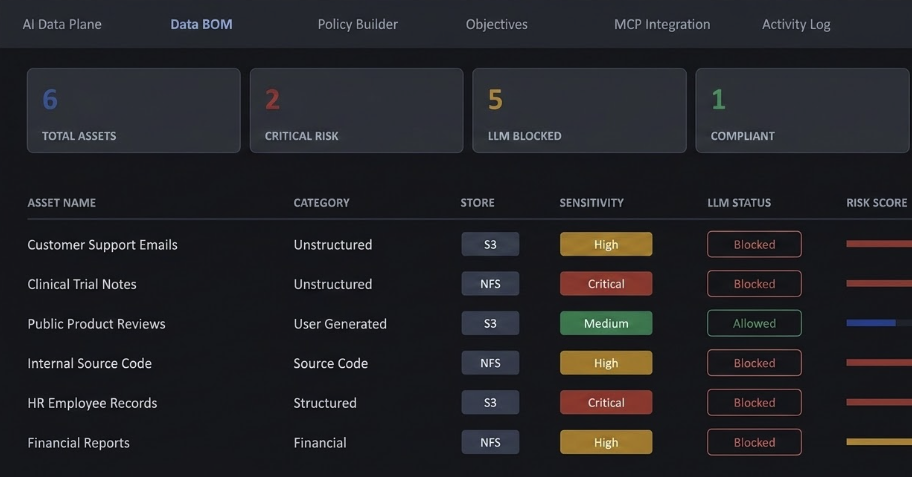
2.0 · TAG & PROVE
Your pipelines act on the tags. The record keeps each region, inclusion and exclusion visible, so the customer answers the auditor without opening a ticket with you.
Explore governance, risk and compliance →No. Secuvy runs inside the customer environment, air-gapped, VPC or hybrid. Nothing is installed on your infrastructure, and you never hold customer files or customer tags.
Inside a regulated or sovereign tier, or attached where the security review starts. The customer buys it for a governance requirement. The workload it unblocks runs on your capacity.
No. First results on customer data come inside a day, so classification runs alongside the pilot.
Every file classified in place, tags for what each of your regions may take, and a record of what was staged and what stayed out.