Secuvy vs Varonis: 2026 comparison

A factual comparison for enterprise teams choosing between permissions-centric data security and governing which data is appropriate for AI.

Decision lens

Varonis

Who can access sensitive data?

Permissions, exposure, activity, and remediation.

Secuvy

Which data belongs in this AI workload?

Classification, context, appropriateness, and DBOM evidence.

Verdict

Varonis is the stronger choice for permissions-centric access governance because its platform emphasizes access graphs, user behavior, and automated remediation of overexposed data. Secuvy is the broader choice for governing data before it enters AI pipelines, especially when teams need non-pattern data classification, contextual linkage across systems, and a DBOM showing what each AI workload used or excluded.

Choose Varonis when the primary job is analyzing who can access sensitive data and remediating excessive permissions.
Choose Secuvy when the primary job is deciding which data is appropriate for AI and proving what entered each pipeline.

At a glance

Compare the operating decision, not the feature count

Both platforms classify sensitive data. The difference is where each one puts its primary control point.

CriterionSecuvyVaronisBottom line
Best fitEnterprise AI and data teams governing which data is appropriate for AI workloads.Security teams prioritizing data access, exposure, threat detection, and remediation.Start with the operating decision: AI input governance or permissions-centric security.
ClassificationSelf-learning classification of pattern and non-pattern data using content, context, and relationships.Contextual classification with out-of-the-box classifiers, policies, and Microsoft Purview integration.Both classify sensitive data. Secuvy centers non-pattern data and AI use-case appropriateness.
AI evidenceA DBOM records pipeline inputs, exclusions, sensitivity, status, policy reason, and destination.Atlas provides AI inventory, risk, governance, audit trails, and runtime controls.Secuvy centers evidence about the source data used by each AI pipeline.
PermissionsMaps data to users, applications, sensitivity, and use.An access graph analyzes entitlements, group membership, sharing links, and permissions, with automated remediation.Varonis has the stronger documented permissions-remediation workflow.
Data handlingClassifies files where they live without moving or changing production files.Covers cloud, SaaS, and on-premises data through SaaS integrations and private collectors.Both support distributed enterprise environments through different operating models.
IntegrationsSecuvy reports support for more than 250 data sources.Broad cloud, SaaS, on-premises, and Microsoft Purview coverage.Validate connector scope against the data estate in the proof of value.
PricingQuote-based. No public list price was found on the current pages reviewed.Quote-based, licensed by user count, with a 30-day unlimited trial.Obtain matched quotes for the same sources, users, modules, and services.

Sources: Secuvy platform overview, Varonis DSPM, Varonis Atlas, and Varonis pricing.

The narrow concession

Where Varonis is stronger

Varonis has the clearer documented advantage when access, exposure, and permissions remediation are the center of the program.

Permissions analysis is the center of the workflow

Varonis documents an access graph that evaluates entitlements, group memberships, sharing links, and permissions around sensitive data. That is a direct fit when the central question is who can reach the data and which exposures should be remediated.

Varonis DSPM

Automated exposure remediation

Varonis combines data sensitivity, access context, user behavior, and remediation workflows. Security teams can use that context to reduce broad access and risky sharing.

Varonis DSPM

Mature security operations support

Gartner Peer Insights feedback highlights visibility into sensitive data and access risk, actionable remediation, platform stability, and responsive support. TrustRadius reports show that implementation and tuning experiences vary.

Independent reviews

Additional implementation context: TrustRadius reviews.

The broader AI data decision

Where Secuvy is stronger

01

Classify the data patterns do not describe

Secuvy identifies non-pattern data, meaning IP and other sensitive or valuable data that pattern-based tools miss because Secuvy understands content, context, and relationships rather than relying only on predefined regex, dictionaries, or known examples.

02

Decide what is appropriate for each AI use case

Secuvy connects related data across systems and maps it to applications, users, sensitivity, and use. Teams define what appropriate means for an AI workload, review recommendations, and keep classification aligned as data changes.

03

Prove what each pipeline used

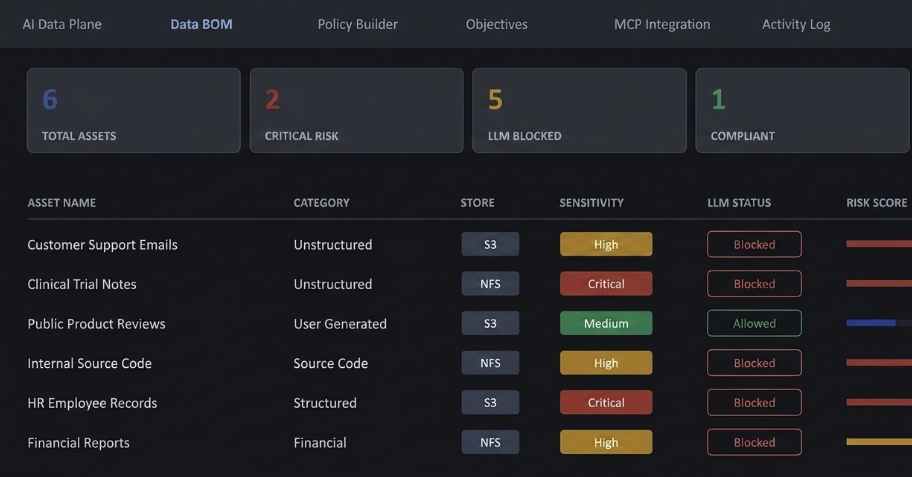
A Secuvy DBOM records what fed an AI pipeline and what was held out, including sensitivity, compliance status, policy reason, and destination.

Explore the platform
Secuvy DBOM showing AI pipeline inputs, exclusions, and status
The DBOM records pipeline inputs, exclusions, and status so teams can review what each AI workload used.

Workflow comparison

The first control point changes the platform decision

Classification and AI governance

Both classify. They organize the decision differently.

Varonis connects classification to permissions, exposure, user activity, threat detection, and remediation. Atlas extends that platform into AI inventory, posture, runtime protection, and governance.

Secuvy starts with the data entering AI. It discovers and classifies files in place, including non-pattern data, links classification to intended use, and produces DBOM evidence for each pipeline.

Varonis DSPM and Varonis Atlas

Deployment and operations

Validate the operating model in your own estate.

Secuvy runs next to the data across on-premises, hybrid, SaaS, and cloud environments. Files remain in their current systems and storage tiers. Secuvy reports support for more than 250 data sources, connection and discovery starting in under one hour, and first results in under 24 hours.

Varonis documents cloud and SaaS integrations plus private collectors for on-premises sources. Independent reviews include strong reports of stability and support alongside reports of setup, tuning, infrastructure, or reporting effort.

Secuvy figures are published vendor claims and should be validated against the buyer’s environment.

Pricing

Neither product publishes a comparable list price

The cheaper option cannot be determined without matched quotes for the same scope.

Secuvy

Quote-based

No public rate card was found on the current product pages reviewed.

Schedule a Demo

Varonis

Quote-based, licensed by user count

Varonis states that customers are not charged based on data volume and that a 30-day unlimited trial is available.

Official pricing page

Compare the same data sources, user population, required modules, deployment services, support level, and ongoing administration.

Best-fit guidance

When to choose each product

Choose Varonis when

  • The primary requirement is permissions analysis and remediation of overexposed sensitive data.
  • Security operations need access auditing, user behavior context, and threat investigation around enterprise data.
  • A mature proof-of-value and support motion is important to the buying process.

Choose Secuvy when

  • AI and data teams must decide which enterprise data is appropriate for each AI use case.
  • Valuable or sensitive non-pattern data is likely to be missed by predefined patterns alone.
  • Teams need contextual linkage and DBOM evidence for pipeline inputs and exclusions.
  • Classification must happen where the data lives without moving or changing production files.

Secuvy does not need to replace every Varonis workflow. In some environments, Varonis can remain the access and exposure control while Secuvy governs the data selected for AI. For a closer replacement-oriented view, see the Varonis alternative guide.

Plain answers

Frequently asked questions

Is Secuvy better than Varonis?
Secuvy is better suited to governing which enterprise data is appropriate for AI pipelines, especially when teams need non-pattern classification, contextual linkage, and DBOM evidence. Varonis is better suited to permissions-centric access governance and automated remediation of overexposed data.
What is the difference between Secuvy and Varonis?
Secuvy centers discovery, classification, and evidence for data entering AI workloads. Varonis centers data access, exposure, user behavior, threat detection, and remediation, while Varonis Atlas also covers broader AI security and governance.
Which product is cheaper?
Neither Secuvy nor Varonis publishes a comparable public list price in the reviewed first-party sources. Varonis licenses by user count, while Secuvy is quote-based. Buyers need matched quotes for the same sources, users, modules, services, and support.
Can Secuvy replace Varonis?
Secuvy can replace Varonis for some classification and AI data-governance requirements, but it is not a universal replacement for Varonis permissions analysis, behavior monitoring, threat detection, or automated exposure remediation. The required control set should determine the answer.
Who should choose Varonis instead?
Teams should choose Varonis instead when their primary requirement is to analyze access to sensitive data, monitor user behavior, investigate activity, and automatically remediate excessive permissions or risky exposure.

References

Sources used for this comparison

First-party product and pricing sources support capabilities. Independent reviews provide operational context, not universal conclusions.

  1. 01Secuvy platform overviewIn-place classification, non-pattern data, contextual linkage, DBOM, source coverage, and published time-to-value figures.
  2. 02Secuvy Varonis alternativeCurrent Secuvy positioning and packaging context. Broad comparative claims were not reused without corroboration.
  3. 03Varonis DSPMClassification, access graph, audit trail, permissions, exposure, environment coverage, and remediation.
  4. 04Varonis Atlas AI SecurityAI inventory, posture, runtime protection, governance, and auditability.
  5. 05Varonis pricingUser-count licensing, no data-volume charge, quote process, and 30-day unlimited trial.
  6. 06Gartner Peer Insights: VaronisIndependent feedback on visibility, access risk, remediation, stability, and support.
  7. 07TrustRadius: Varonis reviewsIndependent reports on capabilities, setup, tuning, infrastructure, reporting, and licensing experiences.

The next step

See the decision on your data

Compare classification coverage, operating effort, and AI pipeline evidence using your own enterprise data and use cases.