Secuvy

Protect ANY Vulnerable Data
from Leaking through ChatGPT

Secuvy prevents leaking vulnerable data through ChatGPT Enterprise, Claude, and Cohere, with automatic tagging and advanced guardrails.

Join the early access waitlist now.

Security Teams leveraging complex data for AI progress

Your biggest LLM risk is real work leaking sensitive data:

  • Sales dropping live customer lists and deal data into AI for “quick analysis”
  • Legal pasting draft M&A contracts into AI to “simplify this for the board”
  • Product and ops sharing internal roadmaps for "quick summaries"
  • Teams handling CUI/ITAR and assuming "our enterprise tools already cover this"

You still want AI. You just can’t afford a leak, not to mention the effort to train staff, evaluate requests, and remediate exposure.

Both advanced data protection AND AI innovation for the business

Prevents leaks of ALL valuable data, WAY more than PII

Contracts, board decks, strategy docs, intellectual property. Protect ALL crown jewel data, not just ones caught by basic patterns or traditional tools.

See your data protection in action

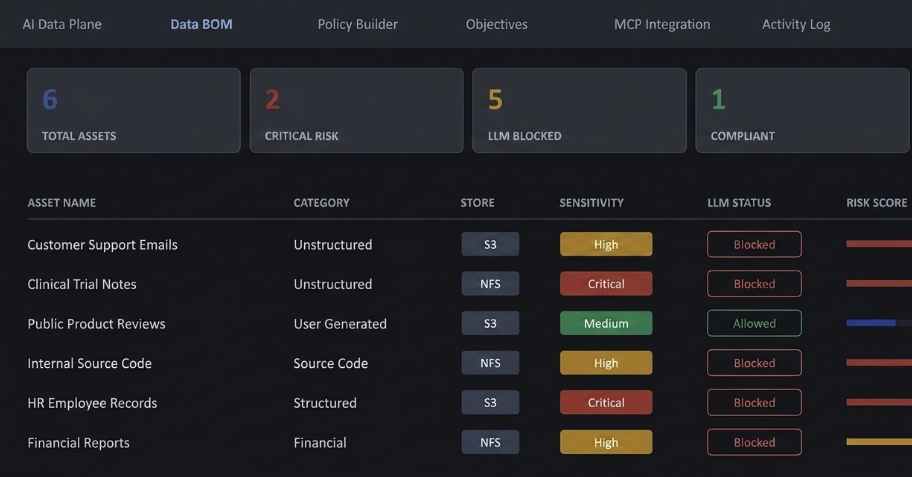
Know where the risk is. Counter risky users, documents, and prompt types with:
- Policies for blocking/masking content
- RAG citation Guardrails
- Role-based data access
- Data Governance rules for NIST, CMMC, and other security frameworks

Enable your coworkers and unburden your team

Enable AI-powered business growth while precisely preventing leaks of your most valuable data, without increasing maintenance time and effort.

Accuracy, Simplicity, and Speed

Keep Accuracy from real-world context, not generic patterns

Tuned for your own complex unstructured docs (contracts, board decks, exports, CUI/ITAR), so it catches what actually matters with fewer false positives and fewer misses.

Simplicity instead of rule-building and heroics

Instead of complex regex and multi-platform policy adjustments, orchestrate your data protection initiative with intuitive conversational prompting.

Speed from minutes-to-value, not months-to-POC

After approval, you can see how Secuvy classifies your real documents in minutes, not after a months-long POC and integration project.

FAQ: Frequently Answered Questions

01How does the free trial work?

Join the early access waitlist, get approved, and instantly access the AutoClassification Agent. Upload a small test corpus (contracts, board decks, policies, support transcripts, etc.). In minutes, see Secuvy classify your unstructured data and run actions like detecting sensitive info, classifying sensitivity, analyzing leak impact, recommending access, previewing policies, and suggesting optimizations.

Test simple policies, e.g., “Block ‘Board-Restricted’ from AI” or “Warn for ‘Confidential – Internal’ but log it.”

It’s a fast POC: no regex building or big projects—just upload and see real results on your docs. Ready to scale? Apply the same logic via the Secuvy MCP Server.

02 What LLM surfaces can Secuvy protect?

Define policies once; the MCP Server enforces them across Microsoft Copilot (Word, Excel, Teams, etc.), enterprise ChatGPT, internal LLM/RAG apps, and backend LLM API workflows.

Examples: Block board/M&A docs from external LLMs; allow wiki snippets but strip customer names; route CUI/ITAR only to approved internal LLMs.

03What types of data can Secuvy detect and classify?

All the easy stuff. Also the hard stuff. The really hard stuff.

Complex unstructured content: IP/product docs, legal deals (NDAs, MSAs), executive/financial materials, customer support logs, regulated data (CUI/ITAR, clinical trials).

04Do you see or train on my data?

No. Classification runs inside your tenant. We never train global models on your data. You control logs, retention, and deletion—data removed when you uninstall.

05How is this different from Microsoft Purview or ChatGPT Enterprise settings?

Native tools are platform-specific, rely on manual labels/regex, and lack unified visibility. Secuvy adds cross-LLM classification, org-tuned unsupervised models, and global risk analytics (e.g., top risky prompts). Complements existing controls with a true LLM guardrail layer.

06Will this wreck my current LLM user experience?

No. You can match speed of rollout to accomodate the needs of your organization. Start monitor-only, then targeted user groups for critical data, then warn/redact for the rest.

Example: User pastes board deck → Secuvy replies, “Contains Board-Restricted info—here’s a safe summary instead.” Users learn fast and keep productivity high with real protection.

07Who is Secuvy AutoClassification Agent for?

Secuvy is built for teams that need LLM security and governance, not just generic DLP:

  • CISOs / Security leaders who need guardrails for ChatGPT and internal LLMs
  • Privacy, legal, and compliance teams that worry about regulated data landing in external models
  • Data / AI platform teams rolling out corporate ChatGPT, RAG apps, and LLM APIs at scale
  • Mid-market and enterprise orgs with lots of unstructured content (docs, decks, tickets, transcripts, wikis, etc.)

If your users are pasting sensitive docs into LLMs faster than you can write regex rules, you’re the target audience.

08Do we have to change our LLM stack to use Secuvy?

No.

Secuvy is LLM-agnostic and plugs in as a policy and classification layer, not a replacement for your LLMs.

  • Keep using ChatGPT Enterprise, internal LLMs, RAG apps, and LLM APIs
  • Add the Secuvy MCP Server to evaluate prompts and documents before they leave your environment
  • Apply consistent policies across different tools instead of re-implementing rules N times

You keep your LLM stack; Secuvy standardizes classification, policy, and visibility across it.

09How does Secuvy classify data without months of setup?

Secuvy uses organization-specific, unsupervised classification:

  • You point it at a sample of your real content (contracts, board decks, strategy docs, tickets, etc.)
  • It learns how your org actually writes and structures information, including domain-specific terms
  • You can optionally define or tweak labels and classes (e.g., Board-Restricted, CUI/ITAR, M&A, Customer PII)

Instead of spending weeks building regexes and keyword lists, you get a working classification model in hours, then refine it based on real results.

10Will this slow down ChatGPT Enterprise for my users?

Secuvy is designed to stay out of the way:

  • Classification and policy checks are optimized to run in milliseconds to low seconds, even on large docs
  • You can choose where to apply heavy analysis (e.g., only for certain apps, doc types, or sensitivity levels)
  • For some workflows, Secuvy can pre-classify common repositories (like SharePoint or internal wikis) to reduce runtime work

The typical user experience:

“My Copilot/ChatGPT still feels fast, I just get warned (or blocked) when I try to send something truly sensitive.”

11What does moving from POC to production look like?

Typical path:

  • Free trial / early access – connect a small corpus, test classifications, and simulate policies.
  • Pilot – enable monitor-only + targeted blocking for one or two business units.
  • Refinement – tune classes and finalize policies.
  • Scale out – extend to more teams and connect to SIEM/DLP.

Because policies are defined once and reused, expanding coverage is mostly about turning on more surfaces, not re-writing rules.

12What do my admins actually manage day-to-day?

Admins typically:

  • Review LLM usage and risk dashboards (top blocked prompts, risky teams, sensitive classes)
  • Fine-tune policies and classes based on business feedback
  • Handle exceptions (e.g., temporarily allow a highly trusted team or project)
  • Export logs and reports for security, legal, and compliance reviews

You’re not constantly editing regexes—most work is policy decisions and tuning, not low-level rule maintenance.

13Can I start only with monitoring and turn on blocking later?

Yes, and that’s the recommended path.

  • Start with monitor-only: classify everything, block nothing
  • Share early insights with stakeholders: “Here’s what people are putting into ChatGPT Enterprise today.”
  • Agree on “never allowed” categories (Board-Restricted, CUI/ITAR, M&A, etc.)
  • Enable targeted blocking + warnings once everyone is aligned

This avoids surprise friction and builds trust that Secuvy is a safety net, not a productivity killer.