
Blog
Insights on data filtering for AI
Practitioner perspectives on getting only appropriate, compliant data into enterprise AI pipelines — from our team and the broader AI data community.

OpenAI’s Privacy Filter Validates a Major Data Problem. Enterprises Have Dozens.
When OpenAI open-sourced its Privacy Filter (OpenAI Privacy Filter GitHub), the enterprise AI community took notice — and rightly so.
Read the article
Secuvy Joins the Armada Bridge Marketplace to Ensure Only the Right Data Powers AI
AI Infrastructure Fails When the Wrong Data Enters the Pipeline Organizations are pushing hard to scale their AI initiatives to drive faster decisions, improve operational efficiency, and unlock new business…
Read
AI Pipeline Data Governance: What CISOs Need to Know in 2026
If your organization is running AI agents or has connected LLMs to internal knowledge bases, there’s a governance gap already open inside your AI program, and your current security stack is most likely not…
Read
Why Enterprise AI Projects Stall – And What the Data Problem Actually Is
There is a number that keeps appearing in enterprise AI conversations, and most teams would rather not talk about it.
Read
Why Data Sovereignty Fails Without Data Intelligence: Lessons from the Agentic AI Era
Enterprises spent years treating data sovereignty as a geography problem.
Read
NVIDIA GTC Said AI Data Is a River, Not a Lake – Here’s What That Means for Your Data Pipeline
Most enterprise AI teams are solving the wrong problem first.
Read
Anthropic Leaked Its Own AI Model – Because Even AI Companies Don’t Know What Data They’re Exposing
A company building the world’s most capable AI model left thousands of sensitive internal files in a publicly searchable data store.
Read
ChatGPT Enterprise vs Reality: Where Data Still Leaks
“HUMANS, as you know, make MISTAKES.” And that single fact is enough to unravel everything your ChatGPT Enterprise license promised to protect.
Read
LLM Data Security: ChatGPT vs Copilot vs Claude Data Risks
If you believe ChatGPT Enterprise, Microsoft Copilot, and Claude are secure for enterprise use, consider these uncomfortable facts: ChatGPT has already suffered a bug that exposed users’ conversation…
Read
How Enterprises Lose Sensitive Data Through AI Assistants
ChatGPT Enterprise prevents OpenAI from training on your data, but it doesn’t stop sensitive data exposure, unauthorized transmission, or regulatory violations.
Read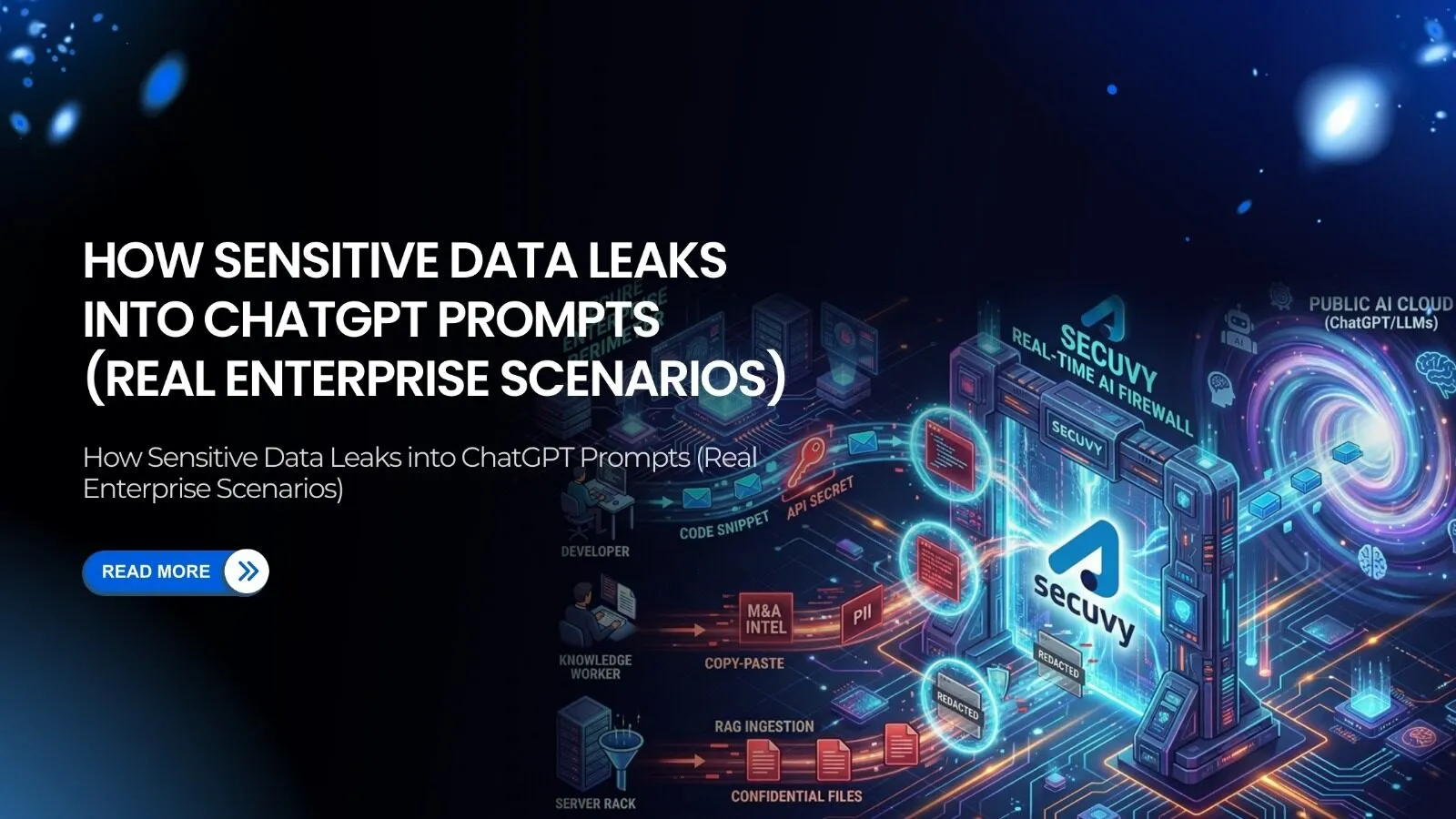
How Sensitive Data Leaks into ChatGPT Prompts (Real Enterprise Scenarios)
“ALERT: SENSITIVE INFORMATION IS LEAKING FROM YOUR SOURCE TO ANOTHER!” Your over-helpful bot would never say that.
Read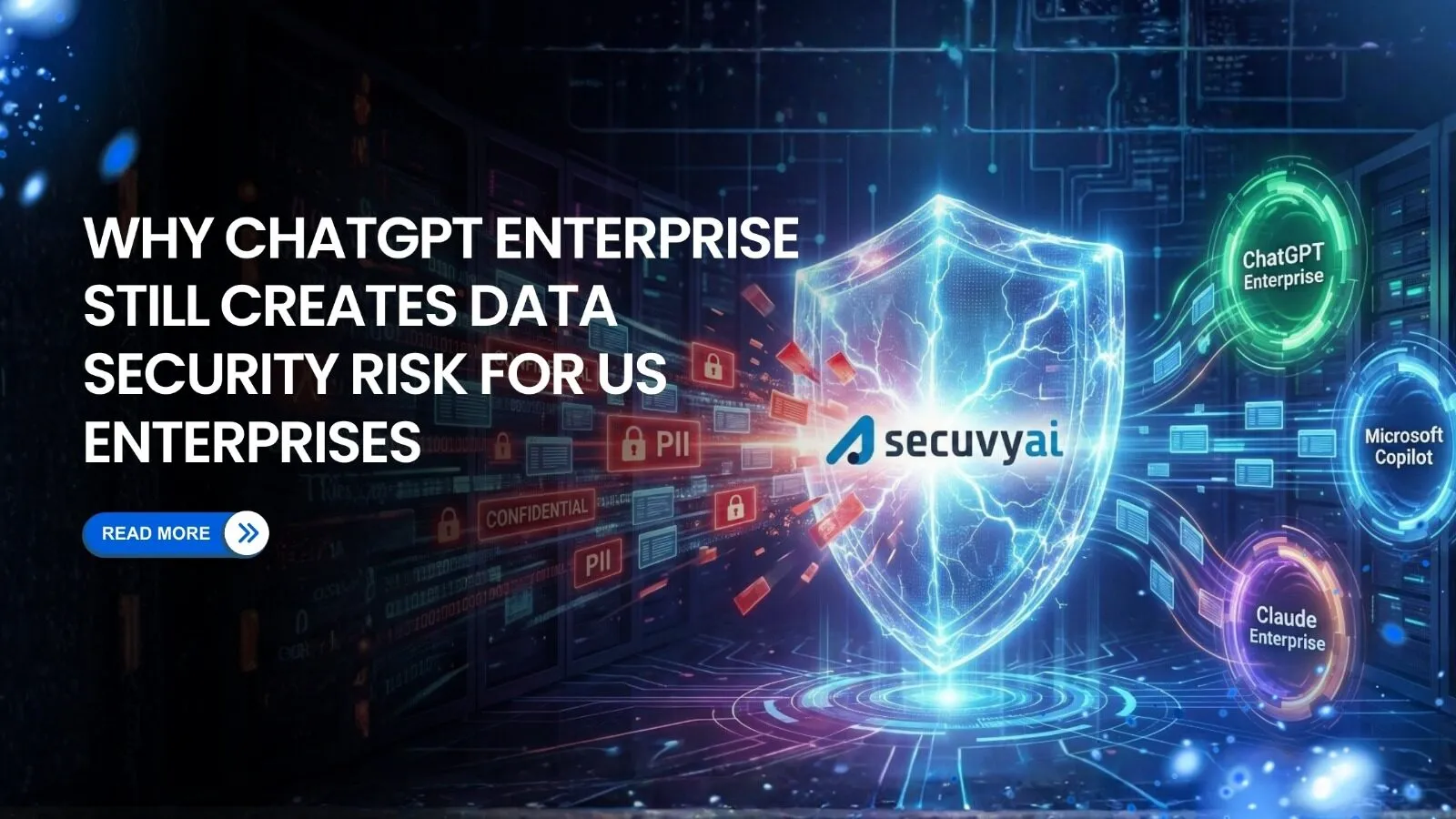
For US Enterprises: How to Protect Data across ChatGPT Enterprise in 2026 (With Examples)
Did you know that Samsung banned ChatGPT & the use of Gen-AI company-wide in 2023?
Read
Best Practices for Data Classification in ISO 42001 Compliance
Using Data Classification for Effective Compliance When working toward ISO 42001 compliance, data classification is essential, particularly for organizations handling large amounts of data.
Read
Getting Started with Data Classification for ISO 42001 Compliance: A How-To Guide
Laying the Groundwork for ISO 42001 Compliance Starting the journey toward ISO 42001 compliance can seem complex, but with a strategic approach, companies can lay a strong foundation.
Read
A Comprehensive Guide To Data Subject Access Request (DSARs)
A Data Subject Access Request (DSAR) is the means by which a consumer can make a written request to enterprises to access any personal data they hold on them.
Read
Vendor Risk Management: What is It, Why is It Important, and More
VRM deals with managing and considering risks commencing from any third-party vendors and suppliers of IT services and products.
Read
All About Data Discovery Tools -Characteristics And Evaluation
With organizations storing years of data in multiple databases, governance of sensitive data is a major cause of concern.
Read
CPRA vs CCPA: What You Need to Know About the Replacement of CCPA in 2023
In 2023, the California Privacy Rights Act (CPRA) will supersede the California Consumer Privacy Act (CCPA), bringing with it a number of changes that businesses need to be aware of.
Read
Opt-in Vs. Opt-out Privacy Rights – All You Need to Know
There has been a phenomenal revolution in digital spaces in the last few years which has completely transformed the way businesses deal with advertising, marketing, or any kind of data sharing.
Read
Mastering EU AI Act Compliance Through AI-Driven Data Classification Methods
For years, tech companies have developed AI systems with minimal oversight.
Read
Understanding AI Compliance: Key Insights for Businesses
Navigating the Shift in AI Compliance Regulations The latest revisions in the Justice Department’s corporate compliance guidelines signal a significant shift for companies that rely on AI technologies.
Read
Role of Data in Ensuring Data Security
Introduction The threat landscape around data security evolves each year due to factors like a lack of robust security measures, improper data handling, and increasingly sophisticated cyberattacks.
Read
New GDPR Report Highlights Rising Enforcement and Data Protection Hurdles
On July 25, 2024, the European Commission released its Second Report on the Application of the General Data Protection Regulation (GDPR), offering an in-depth look into the evolving landscape of data privacy…
Read
Unlocking the Potential of AI with Data Governance, Security, and Compliance
In today’s fast-paced technological landscape, the intersection of AI, data security, and compliance has become a focal point for enterprises aiming to leverage AI’s capabilities while safeguarding sensitive…
Read
Ensure Data Privacy and Fair Decision-making with AI Data Governance
Today Artificial Intelligence (AI) is a part of our day-to-day activities, and knowingly or unknowingly, it impacts our actions and decision-making.
Read
A Letter from the CEO: Executive Actions on Artificial Intelligence
Single platform, privacy-driven security is the future To our colleagues in the data privacy and security space, Over the past few months, I’ve been asked about the White House’s executive order on artificial…
Read
Practical tips for CTOs to handle privacy risks and comply with evolving data laws
Growing concerns over data breaches have led to a flurry of data regulations around the world that are aimed at protecting sensitive information about individuals.
Read
Data Subject Request: What’s the Impact of Not Fulfilling One?
Data Subject Request.
Read
Lessons Learned From Massive Healthcare Cyberattack
It’s not often a cyberattack affects a substantial portion of Americans.
Read
Data Mapping Basics: Inventory Personal Information for Compliance
Inventorize personal information with data mapping and meet compliance requirements Organizations have numerous data sources spread across their IT landscape, which they use to collect, store, and process…
Read
Understanding Washington Health Law: My Health My Data Act aimed at Data Privacy
The State of Washington passed the My Health My Data Act (MHMDA), which is a groundbreaking data privacy law focused on protecting personal health data.
Read
CPRA Compliance Checklist for Businesses
Essential CPRA Compliance Checklist: Ensuring Business Adherence to California’s Data Privacy Regulation The residents of California have a legal right to know what personal information is collected by…
Read
Reduce Attack Surface for Data Breaches With Data Minimization
Reduce Attack Surface for Data Breaches with Data Minimization The General Data Protection Act (GDPR) introduced many regulations around data privacy and how organizations should implement certain rules to…
ReadLarge Language Models (LLMs), Data Privacy and Security: What you Need to Know
What inspired the rise of LLMs and why now?
Read
A Structured Explanation of Unstructured Data
A Structured Explanation of Unstructured Data To corporate Privacy teams, the term “unstructured data” is frequently thrown around.
Read
Unlock the Power of AI for Data Privacy Observability
In today’s data-driven world, where privacy concerns loom large and regulations become increasingly enforced, Privacy teams face the formidable task of safeguarding their organization’s sensitive information…
Read
AI Data Governance for Fair Decision-Making
AI Data Governance for Fair Decision-making Today Artificial Intelligence (AI) is a part of our day-to-day activities, and knowingly or unknowingly, it impacts our actions and decision-making.
Read
CPRA: Do Not Sell or Share My Personal Information
Understanding what is CPRA’s Do Not Sell or Share my Personal Information To protect the privacy of California residents, the state of California introduced the California Consumer Privacy Act (CCPA) data…
Read
Navigating New SEC Rules: The Ultimate Playbook for CISOs
In a significant development, the Securities and Exchange Commission (SEC) implemented new rules effective December 2023, aimed at enhancing transparency and consistency in the disclosure of cybersecurity…
Read
Why Security Teams Need Contextual Data Discovery
As of 2021, we are creating 1.145 trillion MB of data per day.
Read
Enhancing Data Deletion for Global Privacy & Security Compliance with Self-Learning AI
Global privacy and security laws, such as General Data Protection Regulation (GDPR) and the latest edition in India the Digital Personal Data Protection Act (DPDPA) have significantly altered the landscape of…
Read
How Self-Learning AI Greatly Improves Data Discovery & Classification
Secuvy’s unsupervised machine learning algorithms (“self-learning AI”) play a pivotal role in enhancing data discovery and classification processes with our customers.
Read
Seven Foundational Steps to Comply with India’s DPDPA
The Digital Personal Data Protection Act (DPDPA) marks a significant milestone in India’s legislative history, culminating after years of negotiations and false starts.
Read
The Evolving Data Discovery Landscape: Navigating Data Sprawl in the Cloud
Introduction The data discovery challenge is undergoing a profound transformation driven by cloud-native technologies and the rapid pace of application development, fueled by advances in generative AI.
Read
India Digital Personal Data Protection Act: A Primer
A Primer on India’s Digital Personal Data Protection Act In an era where personal data has become a digital currency, the need to strengthen data privacy has never been more evident.
Read
Operationalize Privacy by Design (for Privacy Professionals)
Privacy Impact Assessment (PIAs) are one of the most important tools that help to access the personal information across the organisation.
Read
Universal Data Governance: How to Set Up One?
An organization can make use of universal data governance to stay ahead of its competitors.
Read
Pt 2: Explosion of Large Language Models (LLMs), Unstructured Data and the Need for AI Data Discovery
What every privacy & legal team needs to know.
ReadData Security: The Other Side of Data Privacy
Data Security – The Other side of Data Privacy Privacy has been a buzzword for years, discussed and talked about at different forums for different reasons.
Read
Is CCPA Applicable to your Business?
California Consumer Privacy Act (CCPA) came into implementation from Jan 1st 2020.
Read
How Healthcare Organizations can Discover/Classify/Protect Unstructured Data
Healthcare Organisations have massive amount of Unstructured data.
Read
Find Sensitive Data in Google Drive and Gmail
How Secuvy AI Automates Data Discovery for GSuite Gmail and GDrive are the paramount emails and cloud-based services worldwide.
Read