“HUMANS, as you know, make MISTAKES.”
And that single fact is enough to unravel everything your ChatGPT Enterprise license promised to protect.
OpenAI explicitly promises not to train on your data and secure your IP rights. That is great for protecting your trade secrets from showing up in a competitor’s query, but it does not stop your employees from pasting a European customer list into a US-hosted LLM, violating GDPR instantly.
The platform cannot tell a credit card number from a serial number. It cannot flag ITAR-controlled technical data or recognize a board deck for what it is. It blindly accepts whatever (PII, PHI, CUI) lands in the prompt.
If a user has access to a file, the platform assumes they are allowed to paste it. Every prompt box is an open door, and the only thing standing between your sensitive data and a third-party server is human judgment.
In this blog, we’ll break down exactly where ChatGPT Enterprise’s security ends, how everyday employee workflows are silently leaking sensitive data, and what a real governance layer actually looks like.
What ChatGPT Enterprise Promises (And What It Ignores)
Undoubtedly, OpenAI has built solid infrastructure.
- Encryption: TLS 1.2+ in transit and AES-256 at rest.
- Compliance: SOC 2 Type II certified.
- No Training: Inputs and outputs are excluded from model training.
But here is the catch: ChatGPT doesn’t classify. It consumes.
The platform has no idea what is sensitive until you tell it. It doesn’t automatically know that a 16-digit string is a credit card number (PCI violation) or that a pasted document contains ITAR-controlled technical data.
So basically, your entire data security posture is now riding on thousands of small, daily, well-intentioned decisions made by people working to be more efficient without knowing they might do something illegal (GDPR violation) by clicking ‘enter’ on a third-party LLM.
Real Enterprise Usage Patterns (The “Copy-Paste” Culture)
To understand the leak, you have to look at the intent. Employees aren’t trying to be malicious; they are trying to be fast.
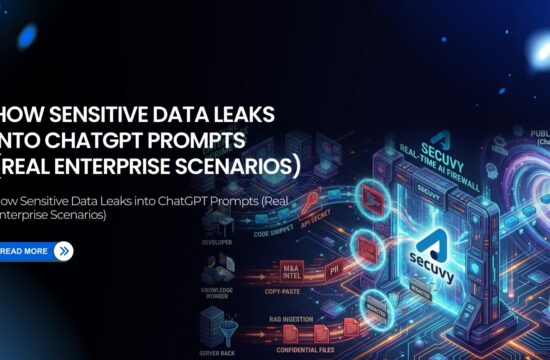
In the real world, LLM data security fails during the mundane “Copy-Paste” workflows that happen thousands of times a day:
- The “Formatter”: An HR manager pastes a chaotic list of employee bonuses and asks, “Format this into a CSV.” (Leak: Salary & PII).
- The “Summarizer”: A Sales VP pastes a 40-page transcript of a client negotiation and asks, “What were their main objections?” (Leak: Confidential Deal Terms).
- The “Debugger”: A developer pastes a stack trace to fix an error. Hidden inside are active API keys and database connection strings. (Leak: Hardcoded Credentials).
In every one of these cases, the data left your secure perimeter and entered a third-party processing environment. The “Enterprise” license didn’t stop it.
Where Native Controls Fall Short
You might be thinking, “We’ll just use Microsoft Purview or DLP to stop this.” Good luck. Native controls were built for a world of files, not prompts.
- Microsoft Purview is Blind Outside M365: Purview is excellent for Word and Excel. But it often fails to control browser-based ChatGPT sessions or data copied from non-Microsoft apps like Slack or Salesforce.
- Regex Fails at Context: Traditional DLP relies on regex patterns (e.g., finding a Social Security Number). It fails miserably at identifying Unstructured Risks like “Proprietary Product Roadmaps” or “Legal Strategy,” which have no fixed pattern.
- Blocking is Futile: If you block ChatGPT at the network level, employees simply switch to personal devices, creating “Shadow AI” that you have zero visibility into.
Closing the Prompt-Level Security Gap
The only way to achieve true GenAI data security is to stop trusting the user and start governing the prompt.
You need an architectural layer that sits between the employee and the AI, acting as a Real-Time AI Firewall.
This is what modern governance looks like:
- Context-Aware Classification: Stop looking for keywords. Use AI to determine whether a document is a “Board Deck” or a “Resignation Letter” based on its meaning.
- Real-Time Interception: Intercept the prompt before it leaves the browser.
- Dynamic Redaction: Don’t just block the user. If Secuvy detects PII, it should automatically redact the sensitive entities and send the sanitized prompt to ChatGPT.
The Result: The employee gets their answer. The enterprise keeps its secrets.
Conclusion
Don’t let an “Enterprise License” lure you into a false sense of security. If you can’t see what your employees are pasting into prompts, you aren’t secure-you’re just lucky. And luck is not a strategy.
Every day without prompt-level governance is another day your data security depends on human judgment alone. Let’s change that. Schedule a Demo to see how Secuvy prevents real-time sensitive data leaks.