
How Sensitive Data Leaks into ChatGPT Prompts (Real Enterprise Scenarios)
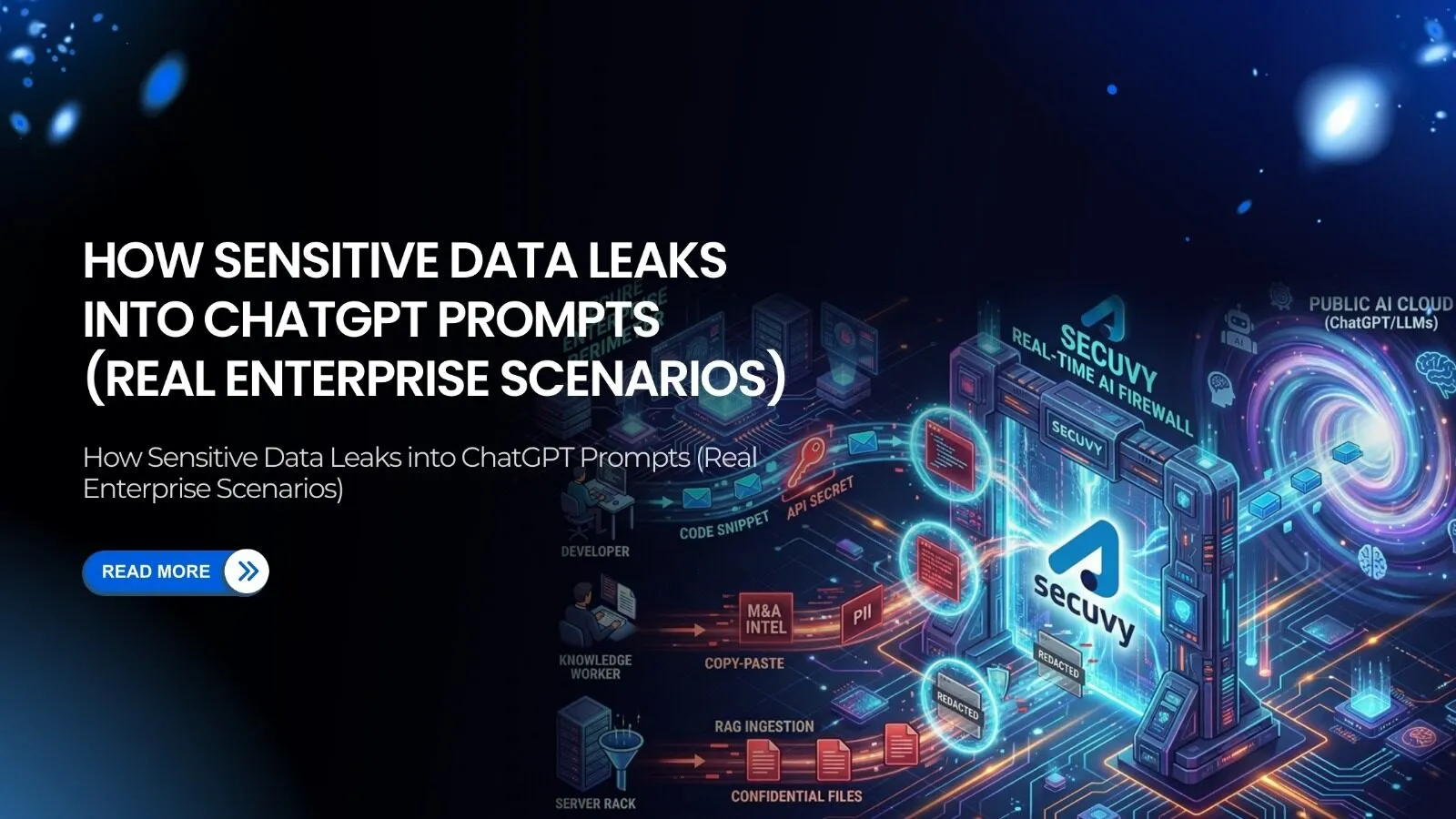
“ALERT: SENSITIVE INFORMATION IS LEAKING FROM YOUR SOURCE TO ANOTHER!”
Your over-helpful bot would never say that. That’s because AI does exactly what it is designed to do.
In modern enterprises, AI assistants serve data. Employees paste documents, code, and internal analysis into ChatGPT to move faster, while RAG-powered bots eagerly fetch answers from internal systems without questioning who should see them and who should not.
These tools are the most efficient data extractors. A single prompt, a single question, and suddenly confidential board decks, production secrets, or HR-restricted data are summarized neatly in a chat window with no alarms, no alerts, no resistance.
The result? Sensitive information eventually leaks into the third-party system.
According to the Data Breach Investigation Report by Verizon, 82% of data breaches involve a human element, including mistakes, misuse of access, or social engineering.
This is the hidden risk most organizations miss: when AI doesn’t understand permissions, context, or intent, it becomes a perfect insider threat leading to data breaches.
If you’re a CISO or an employee, then this blog will help you discover how the breach actually happens in enterprise environments, and why your organization’s current security infrastructure isn’t designed to stop it.
Prompt Copy-Paste Risks in Knowledge Work
The “Copy-Paste” leak is the most common form of ChatGPT sensitive data exposure, and it is almost impossible to catch with traditional Data Loss Prevention (DLP) tools.
Why? Because the data often doesn’t look “sensitive” to a machine. DLP tools excel at catching credit card numbers or social security numbers, but they drastically fail when the risk lives in an unstructured context.
Real-World Scenario: The Board Deck Summary
Your VP of Finance is preparing for the Q3 board meeting. She has a draft slide deck containing unreleased revenue projections, M&A targets, and workforce restructuring plans. To save time, she pastes the complete text or uploads the document into ChatGPT with the prompt: “Rewrite this to be more formal, professional, and easy to understand.”
- The Breach: Material non-public information (MNPI) just entered a third-party LLM.
- The Risk: If OpenAI’s systems face a security threat, or if the data is used to train a model (in non-enterprise versions), your strategic plans and revenue projections could surface in a competitor’s query response.
- Why You Missed It: There was no keyword trigger like “SSN” or “Confidential” that could help the system to understand the sensitivity of the document, leading to no alert signs by the pattern-based tools.
Developer and API-Based AI Usage Blind Spots
While copy-paste is at least visible, developer workflows create a massive “invisible” layer of GenAI data exposure.
Software Developers are rapidly adopting AI coding assistants like GitHub Copilot, Cursor, and custom implementations using the OpenAI API. This poses a security risk because of production codes, which often include hardcoded secrets of the organization that developers typically overlook in their regular workflows.
Real-World Scenario: The “Debug” Paste
Let’s assume a Junior Engineer is troubleshooting a critical production issue. He copies the complete stack trace, including database connection strings, payment gateway API keys, and customer session tokens, and submits it to an LLM with the prompt: “Identify the problem in the stack and fix the error.”
- The Breach: Permanent credentials and infrastructure blueprints are now externalized to a third-party system.
- The Risk: Now, anyone with access to the conversation history (or the model data) has access to the keys to your production environment. This scenario directly mirrors the Samsung incident where engineers inadvertently leaked proprietary semiconductor designs.
RAG Pipelines and Hidden Data Exposure
RAG, Retrieval-Augmented Generation, is the process of optimizing the performance of an AI model by linking LLMs directly to corporate knowledge bases, including SharePoint, Jira, and Confluence.
RAG-based AI systems present the most sophisticated challenge in modern AI data security.
Although the goal is to enable natural language search across company data, the design flaw provides access controls to anyone using it.
Real-World Scenario: The “Over-Helpful” Bot
Your IT team deploys a RAG-powered assistant connected to the company’s SharePoint. A junior employee asks the bot: “Show me the engineering team’s salary structure”.
The system dutifully searches SharePoint, finds a “Confidential – HR Only” folder that the bot has access to (even if the user technically didn’t), and summarizes the compensation data in the chat.
- The Breach: Internal leakage of restricted data to unauthorized employees.
- The Root Cause: RAG systems don’t validate user permissions against source document Access Control Lists (ACLs). It treats all ingested data as “public knowledge” for every user who asks the question.
How Enterprises Can Prevent Prompt-Level Leaks
You cannot stop these leaks by blocking ChatGPT at the network level. Employees will just switch to their personal phones, creating “Shadow AI” that eliminates all visibility and control. Effective LLM data security requires governing the systems.
The Fix: Real-Time AI Firewalls
Instead of trusting employees to self-censor, you need an architectural layer that sits between the user and the AI.
- Context-Aware Classification: Use tools that understand meaning, not just patterns. If a document contains board-level financial data or legal contract language, it should be flagged automatically.
- Real-Time Redaction: Implement a solution that intercepts the prompt before it leaves the browser. It should be capable of notifying: “I’ve detected a customer contact list in your prompt. I will redact personally identifiable information and send the rest of the text so you can still get your summary.”
- RAG Governance: Ensure your AI data pipeline enforces the permissions of the source data, preventing the “Over-Helpful Bot” scenario.
AI adoption in the workplace is inevitable. The era of “Copy-Paste” will continue to exist. Restricting access will only create shadow IT and eliminate complete visibility.
Thus, the security approach must detect and regulate sensitive information proactively, intercepting risk before the “Enter” key is pressed.
Your security architecture needs to be fast enough to catch the leak before the “Enter” key is pressed.
Ready to govern AI at the data level?
Explore how Secuvy delivers context-aware classification and real-time control for ChatGPT, Copilot, and enterprise AI ecosystems.