
How Enterprises Lose Sensitive Data Through AI Assistants
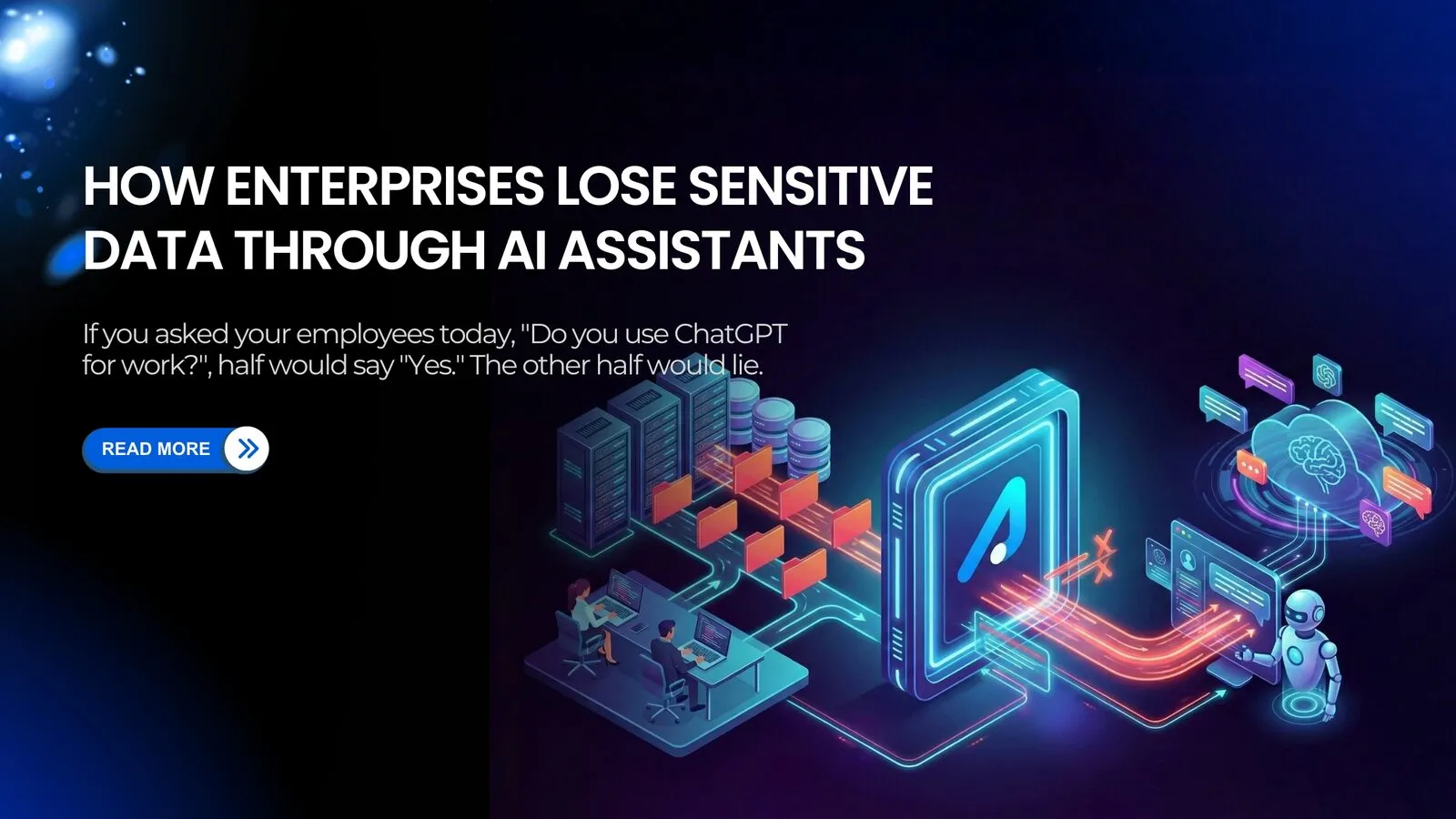
ChatGPT Enterprise prevents OpenAI from training on your data, but it doesn’t stop sensitive data exposure, unauthorized transmission, or regulatory violations.
The moment confidential or regulated information is pasted into an AI assistant, it leaves your security perimeter and enters a third-party processing environment, regardless of licensing or intent.
That risk is real, as 77% of employees are found sharing company secrets on the platform.
This is the current reality of any modern workplace. Employees are rapidly adopting AI to move faster, streamline work, and increase productivity. But in doing so, they may unknowingly expose proprietary data, violate GDPR or CCPA requirements, and create legal risk that security teams never see.
Every time a user hits “Enter” on any prompt across AI platforms, data moves beyond enterprise control. Whether you call it “Shadow AI” or “Productivity,” the result is the same: Increased chances of Data breach, Data theft, and Legal Exposure.
In this blog, you’ll know how sensitive data actually leaves your organization through AI assistants, and why your current safeguards aren’t addressing the real threat.
How Employees Actually Use ChatGPT at Work
To understand the risk, you have to understand the intent. Employees aren’t trying to leak data; they are trying to do their jobs faster.
The exposures occur during routine tasks that bypass conventional security controls:
- The “Formatter”: An HR manager pastes a disorganized list of employee bonuses and asks ChatGPT to “Format this into a clean CSV table.” (Leak: Salary & PII**).**
- The “Summarizer”: A Sales VP pastes a 40-page transcript of a client negotiation and asks, “What were their primary concerns?” (Leak: Confidential Deal Terms**).**
- The “Polisher”: A Director pastes a draft email about a potential acquisition and asks, “Make this sound more professional.” (Leak: Material Non-Public Information**).**
In each scenario, the GenAI data security failure wasn’t malicious exfiltration. It was a productivity-driven copy-paste action.
Why “Enterprise Plans” Don’t Stop Prompt Leakage
A common response from security leaders is: “We purchased ChatGPT Enterprise, so our data is protected. OpenAI doesn’t train on our inputs.”
This is a dangerous misconception.
While Enterprise plans do protect your intellectual property rights (OpenAI won’t learn your secrets), they don’t address data privacy or regulatory compliance requirements.
The Compliance Trap: If a user pastes European customer data into ChatGPT, you have transmitted sensitive data to a third-party processor without a documented legal basis. This potentially violates GDPR or CCPA, regardless of OpenAI’s training policies.
The “Black Box” Log: Even in Enterprise deployments, prompt data persists in chat history logs. If an employee’s account is compromised, every sensitive prompt they’ve ever submitted becomes accessible to the attacker.
ChatGPT data leakage isn’t exclusively about model training. It’s about unauthorized data transmission and storage outside your security perimeter.
Hidden Data Risks in AI-Assisted Coding & Analysis
The highest-risk users in your organization are often your most technical employees: Developers and Data Analysts.
Tools like GitHub Copilot and ChatGPT have become essential for development workflows, but they create specific vulnerabilities:
- Hardcoded Credentials: Developers frequently paste code snippets to “debug” them. If that snippet contains an active AWS access key, database connection string, or API token, those credentials now exist outside your infrastructure.
- Proprietary Algorithms: Pasting your core algorithms to “optimize” them exposes your most valuable IP.
- Unsanitized Datasets: Analysts often upload entire CSVs to leverage ChatGPT’s data analysis capabilities. If that CSV wasn’t scrubbed of PII first, you have just exposed your entire customer database
- Production Configurations: Stack traces and error logs submitted for troubleshooting frequently contain infrastructure details, internal URLs, and system architecture that shouldn’t be externally visible.
The technical sophistication of these users makes the risk invisible to standard DLP tools that look for obvious patterns like credit card numbers.
What Governance Looks Like at Prompt Level
Blocking AI tools isn’t a viable strategy. If you restrict access at the network level, employees will simply use personal devices, moving the risk entirely into the shadows.
The only effective approach is AI data governance implemented at the prompt level. This requires a security layer that operates between the user and the AI model, functioning as a real-time filter for sensitive information.
This is where Secuvy enters the picture.
- Context-Aware filtering: Instead of looking for simple keywords, Secuvy understands that a document is a board presentation, a resignation letter, or a financial forecast based on semantic analysis.
- Dynamic Redaction: Our system intercepts the prompt before they leave your organization’s environment. It can redact names, financial data, credentials, or proprietary information, then forward the sanitized version to the AI system.
The Result: The employee gets their answer. The enterprise keeps its secrets.
The “Honor System” doesn’t work for data security. You cannot rely on employees to manually sanitize every prompt they submit to AI tools.
What you need is an automated, architectural guardrail that allows AI assistant data security without compromising data protection. The choice isn’t between productivity and security. It’s between visibility and blindness.
See how Secuvy secures GenAI prompts in real-time. Schedule a Demo now!