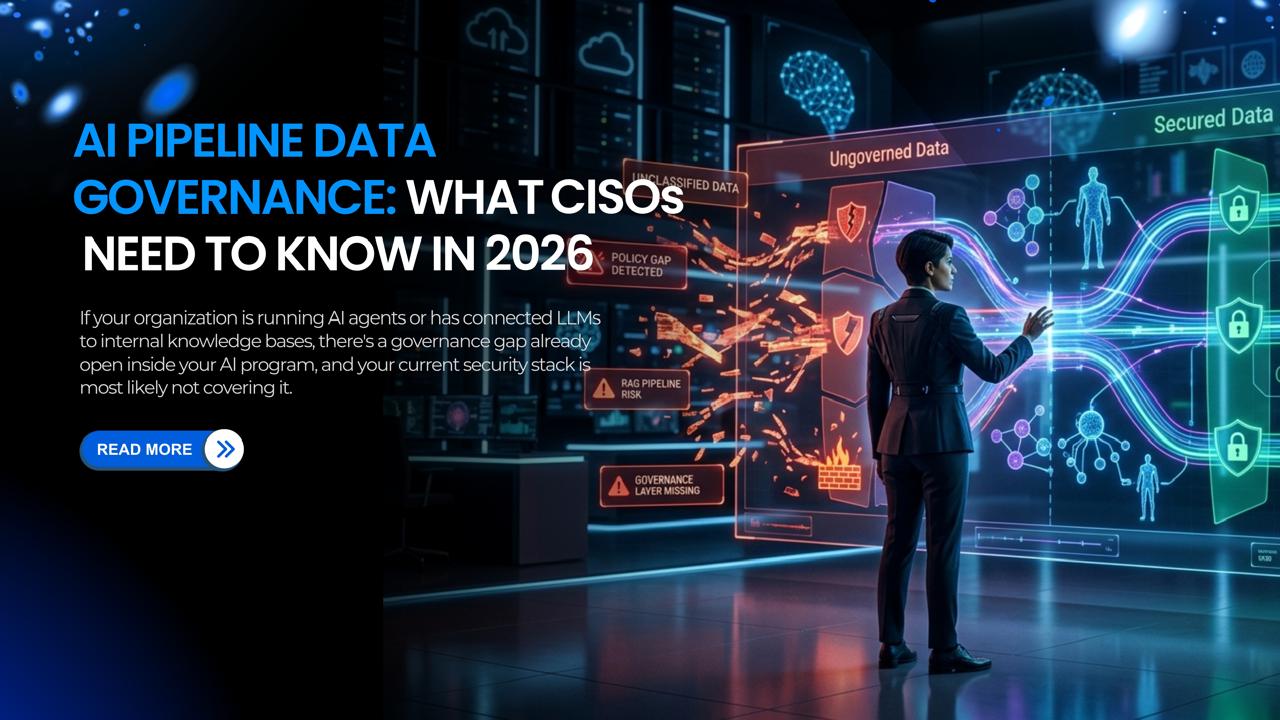
If your organization is running AI agents or has connected LLMs to internal knowledge bases, there’s a governance gap already open inside your AI program, and your current security stack is most likely not covering it.
It’s a gap that sits at the data layer, specifically, in the data that AI agents and RAG pipelines retrieve, process, and generate across organizational boundaries that existing policies were never designed to govern.
This gap has a measurable cost. RAG-related failures accounted for a significant share of enterprise AI incidents in 2025, not because the models were broken, but because the data feeding them was ungoverned, unclassified, and largely unknown to the security teams responsible for protecting it.
Traditional governance frameworks weren’t built for this. They were built for humans to retrieve data from known systems in predictable ways. AI pipelines don’t work like that, and the five controls below reflect what governance should look like when AI agents are doing the retrieving.
Why the Old Governance Model Breaks Down for AI
Traditional data governance rests on two assumptions: that humans are the primary consumers of enterprise data, and that data moves in predictable, controlled ways through known systems and workflows.
AI pipelines break both.
An AI agent doesn’t query a single approved data source. It retrieves documents across file shares, SharePoint sites, databases, SaaS platforms, and cloud storage simultaneously, often in real time, without a human review step anywhere in the chain. A RAG pipeline connected to an internal knowledge base doesn’t respect the organizational chart or the classification labels applied to a folder structure three years ago. It retrieves what it can reach, at a scale and speed that no manual review process can keep pace with.
The result is a category of data risk that most governance frameworks have not caught up to. According to CSO Online, 51% of all enterprise AI failures in 2025 were RAG-related. That is not a model quality problem. That is a data quality and governance problem.
The question for security leaders is not whether to govern AI pipelines. The question is which specific controls need to be in place, and whether your current stack is actually providing them.
Here are five governance controls that matter most.
Control 1: Classify What the Pipeline Can Reach Before It Reaches It
The most common AI data governance failure isn’t a breach. It’s an unreviewed connection. An AI pipeline gets pointed at a data source, the team confirms that access permissions are correct, and the project moves forward. What the team hasn’t confirmed is what that data source actually contains.
A shared drive with correct access permissions may also contain unreleased financial documents, personal health information from a legacy HR system, or proprietary research that predates the current IP classification framework. Permissions say who can access data. Classification says what that data is and whether it belongs in an AI context at all.
Data sources feeding AI pipelines need to be classified before ingestion, not after a problem surfaces. That classification needs to cover unstructured content, documents, emails, presentations, files of all types, not just the structured database records that pattern-based tools handle easily.
Control 2: Apply Governance at the Data Layer, Not Just the Access Layer
Access controls determine who can retrieve data. They don’t determine whether retrieved data is appropriate for a specific AI application and that distinction matters more than most governance frameworks currently account for.
The same data source may be appropriate for one AI use case and entirely inappropriate for another. An internal document repository might be a valid source for a customer-facing chat assistant, but an inappropriate source for a fine-tuning dataset. The access permission is identical in both cases. The governance requirement is completely different.
Data-layer governance means the appropriateness determination happens at the level of the data itself, based on what it contains, rather than relying solely on access policies defined at the system level. Without it, the access layer creates a false sense of coverage for a risk it was never designed to address.
Control 3: Monitor What Data Actually Enters AI Systems
Most security teams can tell you who has access to their data warehouse. Very few can tell you exactly which documents entered a specific AI pipeline last week, what those documents contained, or whether any of them should have been excluded.
This is the audit trail problem and it has direct compliance implications. Frameworks including GDPR, HIPAA, and CMMC increasingly require organizations to demonstrate not just that controls were in place, but that those controls produced verifiable outcomes. For AI systems, that means producing evidence of what data entered a model or retrieval system, when, and under what governance policy.
Without continuous monitoring at the AI pipeline level, that evidence doesn’t exist. Audit responses become estimates rather than records. And in the event of an incident, the security team can’t reconstruct what the AI system actually saw, which is precisely the question regulators and auditors will ask first.
Control 4: Govern Generated and Intermediate Data, Not Just Source Data
AI pipelines don’t only consume data; they produce it. A RAG system generates responses. An agent creates intermediate outputs, summaries, and action logs. A fine-tuning process produces model weights that encode information from the training dataset.
Each of these outputs may carry sensitive information derived from source data, even when the output itself doesn’t resemble the original record. A summary generated from a confidential contract may expose the essential terms. A model trained on customer PII may allow that information to be reconstructed under certain conditions.
Governance that stops at the input layer leaves the output layer completely unmonitored. Effective AI pipeline governance needs to cover what comes out, not only what goes in.
Control 5: Keep Classification Current as Data Changes
Data doesn’t stay still. Files get updated. New records get created. Documents move between systems. A governance scan conducted at the start of an AI project reflects the data estate as it existed on that day and three months later, the estate has changed significantly, while the governance baseline hasn’t.
This is especially problematic for RAG pipelines operating against live data sources. The retrieval index updates continuously. The governance assessment doesn’t. The pipeline starts retrieving newly created or recently modified documents that have never been reviewed, classified, or approved for AI use, and nobody knows it’s happening.
Continuous classification closes this gap. Rather than periodic audits, a continuous intelligence layer monitors the data estate as it changes and updates governance attributes accordingly. When a new file appears in a source connected to an AI pipeline, it gets classified immediately. When an existing file is modified, its classification gets reviewed, not on the next audit cycle, but as the change happens.
What These 5 Controls Have in Common
All five controls share the same dependency: accurate, current knowledge of what enterprise data actually contains. Not where it lives. Not who has access to it. What it is.
That’s the function a continuous data intelligence platform needs to deliver at the data layer. The right solution continuously discovers and classifies enterprise data across cloud, on-premises, and SaaS environments using self-learning AI, identifying sensitive, regulated, proprietary, and inappropriate content before it reaches AI systems. It maintains a continuous record of what data feeds each pipeline-connected source. And it monitors for changes, updating classifications as the data estate evolves rather than waiting for the next scheduled scan.
This is exactly what Secuvy provides. For CISOs working through AI governance requirements in 2026, the platform closes each of the five gaps above, giving security teams the real-time data visibility that AI pipeline governance requires but that most enterprise security stacks don’t currently deliver.
The Governance Gap Is at the Data Layer
Access policies, network controls, and identity management are necessary. They’re not sufficient for governing AI pipelines. The risk isn’t in who can reach your data; it’s in what your AI systems are retrieving from it, in real time, without classification, monitoring, or an audit trail.
That’s a gap most enterprise AI programs are currently running with. It’s also a gap that continuous data intelligence closes before the audit, before the incident, and before the pipeline scales beyond the point where the problem becomes expensive to fix.
See how Secuvy closes the AI pipeline data governance gap for enterprise security teams. Schedule a strategy call at secuvy.ai